 由 Yaming
 Introduction to washing machine production line
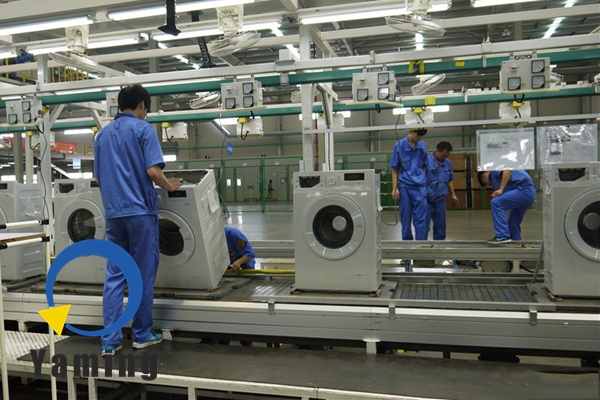
The washing machine production line is a standardized automated equipment specially used to produce household and commercial washing machines. The process is “processing parts-core assembly-comprehensive inspection-packaging and warehousing”. Relying on plate chain transportation and modular tooling, parts can be efficiently turned into finished products. Washing machines, whether it is a drum, a pulsator or an integrated washing and drying machine, can be produced with different capacities and functions.
1. Core transportation and assembly system
The production line mainly relies on plate chains for transportation. The load-bearing plates are made of carbon steel, stainless steel, wood or plastic steel and are fixed on the chains on the guide rails on both sides of the conveyor. They are strong and stable. Light plate chain: Each workstation can bear a weight of about 100 kilograms. It is suitable for transporting components such as shell and liner of household washing machines. It is commonly used in the home appliance industry;
Heavy plate chain: It can bear up to 2 tons and is suitable for transporting large commercial washing machines or overweight parts. High degree of automation during assembly: the washing machine shell can be automatically stored in separate lanes and assembled according to the rhythm; automatically turning the box to adjust the shell angle to facilitate parts installation; automatically pressing to detect whether the shell leaks; also can automatically place the bottom support and automatically position, making subsequent assembly more accurate.
2. Modular assembly line
Assembly is carried out in the order of “installing core components-installing functional components-improving details”, and the efficiency is accurate and high:
First install the core parts such as the liner, motor, and transmission system, and use special tooling to position them accurately and rotate smoothly; Then the AGV cart delivers accessories such as the control panel, water inlet valve, drainage pump, and detergent box. Workers use torque tools to fix them. The interfaces are all standard and will not be installed incorrectly; The all-in-one washing and drying machine is equipped with additional drying and condensation modules, and finally the shell, door body or top cover are installed, and sealing strips are pasted to complete the assembly. Scan the code to record the part information, and the production process can be checked.
3. Full performance testing line
The inspection process is strictly controlled to ensure that the products meet the national standards: First look at the appearance, check whether there are scratches, parts installed uneven;
Then simulate actual use to test the cleaning effect, dehydration effect, operating noise, and whether the shell leaks; The key is to measure electrical safety, check whether the insulation is good or not and whether the leakage protection is effective; The washing and drying machine should also measure the drying speed and temperature control accuracy.
Unqualified items will be returned to the factory for maintenance, and those that pass will be packaged after cleaning them.
If you have any questions or needs about the automated assembly line, please contact us via email: [email protected]