 由 Yaming
 Modern Electric Tricycle Assembly Line and Manufacturing Process
1. Company Profile
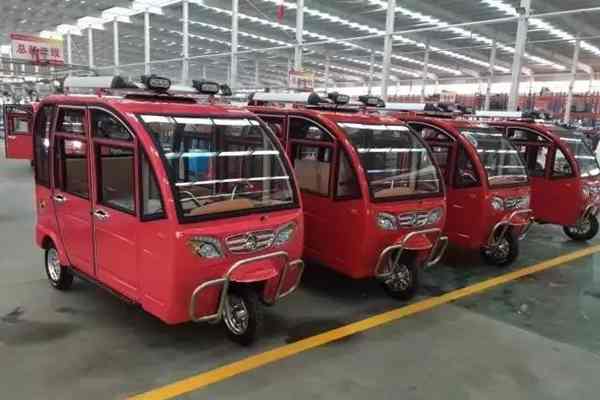
We are a dedicated manufacturer of enclosed electric three-wheelers, operating from a large-scale, standardized production plant. The photograph captures our main assembly hall, where rows of red enclosed tricycles are precisely aligned along clearly marked floor lines. This reflects a disciplined, high-volume manufacturing environment. Our expertise centers on assembly line design, process engineering, and systematic production flow management.
2. Assembly Line Layout and Station Design
Our facility operates a linear assembly line with defined workstations marked by yellow floor lines. This layout ensures each vehicle progresses through a controlled, sequential production process—starting with chassis assembly, followed by powertrain installation, body panel fitting, and final inspection.
The line is organized according to takt time principles. Each station is allocated a specific set of tasks, and operators synchronize their work within a fixed cycle as vehicles advance. This structure prevents bottlenecks and eliminates idle time. The orderly arrangement of finished units visible in the image is a direct result of this paced workflow.
3. Key Assembly Process Stages
Chassis and Frame Assembly
Assembly begins with the chassis station, where the welded frame is set in place. The front axle, rear axle, suspension, and braking systems are installed here. A sub-assembly approach is used: undercarriage components are pre-assembled on a parallel auxiliary line, then lifted as a complete module onto the main line. This parallel processing strategy reduces main-line cycle time and increases overall throughput.
Powertrain Installation
At the powertrain station, the motor, controller, battery pack, and drivetrain are integrated. All critical fasteners are torqued to specification using calibrated tools, ensuring consistent clamping force and preventing connection failures in the field.
Body Panel and Cabin Assembly
The enclosed cabin, doors, windscreen, roof, and front fascia are mounted at this stage. Dedicated locating fixtures and jigs hold body panels in place during fastening, achieving uniform panel gaps and flush surfaces across all units. The red enclosed bodies in the photograph demonstrate the consistent quality from this precision-focused station.
Electrical and Interior Trim
This station covers dashboard installation, lighting systems, wiring harness routing, and interior trim fitting. All electrical connections follow standardized routing paths and are secured with cable ties and grommets to prevent abrasion and ensure long-term reliability.
End-of-Line Testing and Release
Every completed vehicle undergoes a series of checks, including brake performance testing, lighting verification, a short road test, and a final visual inspection. Units that fail any checkpoint are diverted to a rework bay and are not released until all non-conformances are resolved.
4. Process Engineering and Quality Systems
Standardized Work Instructions
Each workstation is supported by documented instructions specifying sequences, torque values, and quality criteria. This ensures consistent product quality across shifts and operators.
Visual Management
Clear floor markings, uniform vehicle spacing, and organized tooling are all part of a visual management system. Production status is immediately visible to supervisors and engineers, enabling swift identification of any deviations.
Traceability
Every vehicle is assigned a production record that captures key process data—torque readings, electrical test results, and inspection sign-offs. This provides full traceability from raw materials to finished product.
Flexible Line Configuration
While optimized for our standard enclosed tricycle platform, the line can be reconfigured for variant models with minimal downtime. Quick-release fixtures and modular tooling support this adaptability.
5. Continuous Improvement
We operate according to lean manufacturing principles, actively targeting the seven wastes: overproduction, waiting, transport, over-processing, inventory, unnecessary motion, and defects. Regular line balancing studies and time-motion analyses are conducted to eliminate non-value-added activities and maintain competitive cycle times.
Looking ahead, we are evaluating the implementation of semi-automated guided vehicles (AGVs) for line-side material delivery, as well as digital torque data collection systems to further refine process control and reduce manual recording errors.
If you have any questions or needs about the automated assembly line, please contact us via email: [email protected]