 由 Yaming
 Full analysis of electric scooter assembly line production
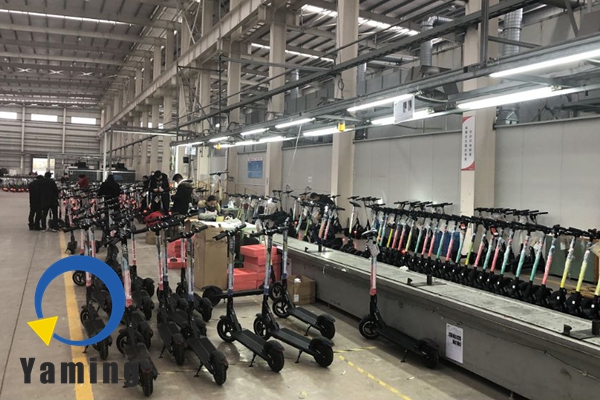
Relying on automation, the electric scooter assembly line connects frame welding, component assembly, testing and other links in series. Through process coordination and quality control, it efficiently produces standardized products, adapts to shared and personal travel scenarios, and helps short-distance travel tool manufacturing reduce costs and improve efficiency.
1. Structure and core components
(1) Carrying and walking The frame serves as the basic “skeleton”. Aluminum alloy (obvious advantages in light weight) is commonly used to adapt to shared scenarios, and high-carbon steel (low cost and sufficient rigidity) is used for low-end models. Various wheel designs: shared scooters are equipped with solid rubber wheels (maintenance-free and wear-resistant); personal models can be equipped with pneumatic wheels (good shock absorption and smooth riding); some high-end models use honeycomb tires, taking into account shock absorption and maintenance-free characteristics.
(2) Power and energy The motor is the “heart” of power. In-wheel motors have become the mainstream of the market due to their compact structure and simple wiring; the power output of the mid-mounted motors is linear and meets the needs of off-road modification. Most of the batteries are lithium cells. The shared models focus on basic battery life, and the personal models can be customized for longer battery life on demand. With the help of the Battery Management System (BMS), voltage and temperature can be monitored in real time to ensure charge and discharge safety.
2. Core of the assembly line: process and automation
(1) Frame manufacturing Cutting: The CNC pipe cutter accurately cuts pipes based on the design model and adapts to the needs of different frame size. Welding: Collaborative robots perform arc welding operations, monitor the welding process in real time, and automatically repair welding in case of abnormalities to ensure a firm frame structure. Polishing: The robot cooperates with a flexible abrasive belt to polish the frame welds and nozzles to optimize surface flatness and prepare for subsequent processes.
(2) Component assembly Walking system: Pneumatic clamps fix the frame, workers or robots connect the wheels to the frame through bolts, and use an automatic balancer to detect the state of the wheel set to ensure installation accuracy. Power system: The in-wheel motor is electrically connected to the frame through a quick-plug connector. After the battery pack is embedded in the frame cavity, sensors are used to verify the installation in place. Control system: Scan the code and call the corresponding vehicle type program to automatically complete the wiring to avoid the risk of wrong connection and ensure the adaptability of the electrical system.
3. Test system: performance and safety verification
(1) Electrical testing Insulation test: Apply voltage test to ensure that the insulation performance of electrical components meets the standard and avoid the risk of leakage. Functional verification: Simulate throttle, brake and other signals, test motor response speed and instrument display accuracy, and ensure normal functions. Communication test: Verify communication between the battery management system and the controller to ensure that battery status (voltage, temperature, etc.) can be fed back in real time.
(2) Real vehicle verification Road condition simulation: Use a test bench to simulate climbing, bumpy road and other scenarios, run for a certain period of time, monitor the temperature rise of the motor, abnormal noise of the frame, etc., and test the stability of the vehicle. Brake test: Trigger the brake at a set speed to test the uniformity of braking distance and braking force to ensure riding safety. Waterproof test: Simulate different environments by spraying and other methods to test the tightness of electrical components to ensure normal use in rainy days and other scenarios.
4. Value implementation
The assembly line achieves improved production efficiency, reduced labor costs, and effective control of defective rates. With the help of the system, you can quickly switch models and adapt to diverse order needs. The entire process follows industry standards, finds a balance between large-scale production and safe travel, lays a solid foundation for the development of the short-distance travel tool industry, and promotes the standardization and efficiency of the industry.
If you have any questions or needs about the automated assembly line, please contact us via email: [email protected]