 由 Yaming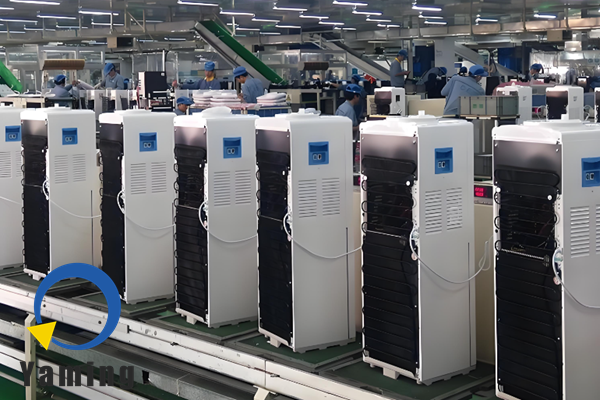
1. Water Dispenser Production Line Overview
The water dispenser production line is an automated system for drinking water heating/cooling equipment, following a core process: precision shell processing → waterway component assembly → circuit integration → full-machine inspection → packaging & storage.
Leveraging CNC equipment, tooling positioning, and safety testing systems, it transforms raw materials into finished products—supporting flexible production of multi-spec models (desktop/vertical, hot/cold, instant-heating).
2. Shell Processing Line: Lightweight & Consistency
As the external protective structure, this line prioritizes lightweight design (ABS plastic/cold-rolled steel) and appearance consistency to adapt to diverse models.
First, CNC punches cut materials based on model needs (desktop/vertical), reserving water inlet/outlet and control panel holes with error ≤±0.1mm to ensure part alignment. Then, plastic shells are integrally molded via automated injection machines (e.g., bases, side panels), while metal shells are folded into frames via CNC bending—automated polishing removes burrs to prevent scratches.
Post-forming, plastic parts receive matte/high-gloss coating (dust-free spraying for texture); metal parts undergo phosphating and rust-preventive treatment. Conveyor belts connect stations to minimize appearance flaws from manual handling.
3. Waterway Component Assembly Line: Sealing & Adaptation
This stage focuses on waterway sealing and hot/cold module adaptation, using a “workstation zoning + tooling positioning” model.
Conveyor lines transfer shells to waterway stations: workers install water tanks (adapting to 10L/15L capacities) and seal rings, aligning with housing slots to prevent leakage. AGVs then dispatch components (heating cans, refrigeration chips, filter elements) to workstations, where workers use positioning tooling to fix parts.
Heating cans and water pipes connect with food-grade silicone seals; torque wrenches (5–8N·m) tighten connections. Airtightness tools test waterways at 0.3MPa for 30 seconds—no pressure drop means qualification.
4. Circuit Integrated Assembly Line: Electrical Safety
This stage prioritizes electricity safety, using a “modular integration + error-proof management” model to isolate circuits from waterways.
Automated mounters weld temperature controllers, relays, and power interfaces on PCB boards, forming circuit control modules (adapting to 1500W/2200W power needs). Workers install these modules into housing compartments (physically isolated from waterways to prevent seepage), then connect power cords for heating/cooling components and control panel signal cords.
Heating points are reinforced with insulating terminals to prevent loosening. Circuit tests verify temperature control (heat to 95°C, cool to 5°C) and grounding resistance (≤4Ω), with all parameters recorded for traceability.
5. Complete Machine Inspection Line: Quality & Compliance
Multi-station inspection verifies function, safety, and performance to meet standards.
- Appearance & Function: Visual systems detect shell scratches and component flatness; control panel button sensitivity is tested.
- Waterway Performance: Simulating use, tests measure flow rate (hot/cold outlet deviation ≤0.2L/min), heating speed (to 95°C ≤15 mins), and cooling speed (to 5°C ≤30 mins)—waterway tightness is retested.
- Safety Checks: Equipment tests leakage protection (auto power-off within 0.1s) and insulation resistance (≥100MΩ, meeting 3C standards). Unqualified units divert to maintenance; qualified ones proceed to cleaning.
6. Finished Product Packaging & Storage Line: Protection & Traceability
This stage ensures safe transportation and efficient storage for diverse models.
Qualified dispensers are wrapped in dust film via automated coating, then packed into custom cartons (desktop/vertical) with foam corner protectors (shielding control panels and water outlets). Labels encode model, power, batch, and warnings (moisture-proof, handle with care).
Post-packaging, AGVs transport products to intelligent storage areas (categorized by “model + function type”), with MES updating inventory data in real time for rapid order sorting.
7. Core Advantages
- Safety & Precision: 100% waterway seal testing and 3C-compliant circuit safety; core processes achieve >70% automation, with key size errors ≤0.1mm—ensuring safe, stable performance.
- Flexible Production: Supports mixed production of multi-spec dispensers (desktop/vertical, hot/cold). Model changes take ≤1 hour (via tooling adjustment) to adapt to small batches and diverse orders.
- Intelligent Management: MES collects real-time data (shell pass rates, leakage rates) to predict equipment failures (reducing shutdowns by 25%). Each dispenser has a unique traceability code, linking to processing, assembly, and testing for quality control.

- If you have any questions or needs about the automated assembly line, please contact us via email: [email protected]