 由 Yaming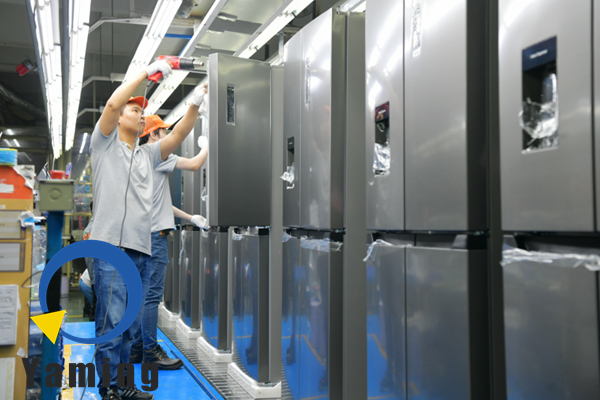
Introduction to the Refrigerator Production Line
The refrigerator production line is an automated system designed for large-scale manufacturing, with a core workflow of “structural processing – component assembly – finished product inspection – packaging & warehousing”. By integrating equipment collaboration and standardized operations, it ensures production efficiency while adapting to the manufacturing needs of multi-specification refrigerators.
1. Structural Parts Processing
This stage uses CNC equipment to process refrigerator boxes and door frames with high precision. A CNC punching machine first cuts metal plates according to fridge specifications, reserves installation holes accurately, and controls errors within a narrow range. Next, a CNC bending machine folds these plates into box cavities and door frames, with key structural points reinforced by automated welding to ensure stability. After forming, structural parts undergo automatic polishing and derusting, followed by an electrostatic spraying line that applies a moisture-resistant coating—critical for adapting to the fridge’s humid internal environment. Finally, a conveyor transports the processed parts to the next stage, minimizing manual intervention and maintaining consistent processing quality.
2. Component Assembly
The assembly process adopts a “conveying line + functional station” model to ensure orderly operations. A circular conveying line sequentially moves fridge boxes to each workstation, while AGV unmanned vehicles synchronously distribute specialized parts (compressors, evaporators, temperature control panels) to avoid material mismatches. Workers use smart torque wrenches for basic installations, with robotic arms assisting in high-precision tasks (such as door hinge alignment and pipeline docking) to guarantee assembly accuracy—directly impacting the fridge’s sealing performance and cooling efficiency. Throughout assembly, barcode scanning records part information and operation data, enabling full-process traceability and preventing missing or incorrect installations.
3. Finished Product Inspection
This stage features multi-station testing to comprehensively control product quality. The first workstation uses visual inspection equipment to check for box scratches and door gaps. Subsequent stations employ specialized tools to test cooling speed (e.g., ensuring the freezing chamber reaches -18°C within 1 hour), temperature uniformity, and door tightness. A final simulated operation test verifies overall stability under varying temperature and humidity conditions. All test data is uploaded in real time: unqualified products are automatically diverted for maintenance, while qualified ones proceed to packaging—ensuring outgoing products meet strict quality standards.
4. Packaging & Warehousing Integration
This link achieves seamless automation between packaging and warehousing. Qualified refrigerators are automatically wrapped in protective film, boxed, and labeled with production details for easy traceability. AGV vehicles then transport packaged units to a smart storage area, where products are sorted and stored by specification. This zoning simplifies order fulfillment, reduces labor costs, and minimizes product damage during storage.
5. Core Advantages
- Efficient Automation: Over 80% of core processes are automated, with a single line achieving a daily capacity of 1,000 units—significantly boosting production efficiency.
- Flexible Production: Quick changeovers (within 1 hour) support multi-specification models (e.g., double-door fridges), enabling agile responses to order variations.
- Intelligent Management: Real-time data collection tracks key metrics (capacity, defect rates) and triggers fault warnings, reducing unplanned downtime
