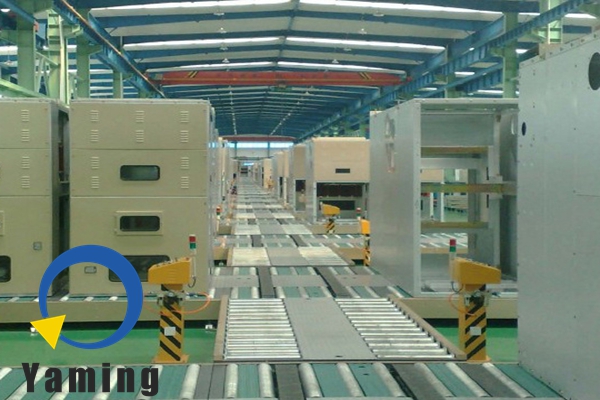
The switchgear assembly line is a standardized and automated production system designed for the manufacturing and design of electrical equipment. With “precision machining-orderly assembly-strict testing” as the core process, it achieves efficient and stable large-scale production through equipment integration and process optimization., adapt to the manufacturing needs of multi-specification products.
1. Metal Component Processing Line
This production line leverages CNC equipment for precise forming and surface treatment of metal components. It starts with a CNC punching machine, which auto – adjusts cutting/punching parameters based on production needs to standardize metal plate processing—ensuring uniform component sizes and hole – location accuracy. Next, CNC bending equipment bends plates per preset procedures to form frame – like components. Automated welding equipment then strengthens and welds key connections for structural stability. Finally, automated polishing/derusting equipment treats component surfaces, followed by an automatic spraying line that applies a protective coating evenly. The entire process relies on equipment linkage for continuous operation, reducing manual intervention and ensuring processing consistency.
2. Component Assembly Line
The assembly line adopts a work – based flow design, using a conveying line to enable orderly material and component flow. The conveying line transfers components to be assembled to each functional station sequentially. An AGV unmanned handling system delivers components to corresponding stations via preset routes, avoiding material buildup and mismatches. Each assembly station is equipped with intelligent auxiliary tools, allowing workers to complete tasks like component fixing and wiring—ensuring operations meet standardization requirements.
3. Finished Product Inspection Line
The inspection line uses a multi – station series design to establish a full – dimensional quality control system. The first station checks appearance and size via visual recognition and measurement tools, identifying surface defects, assembly flatness issues, or size deviations. Subsequent stations test electrical performance, connection stability, and other indicators using specialized equipment. A final simulated – operation station verifies overall product functionality by replicating real – use scenarios. All test data uploads to the management system in real time: unqualified products divert to a dedicated area, while qualified ones proceed—ensuring product quality stability.
4. Core Advantages of the Assembly Line
Automation & Intelligence: Integrates CNC, AGV, and smart tools for minimal manual intervention.
Flexible Production: Adapts to diverse component processing/assembly needs with modular equipment.
Standardization & Traceability: Enforces uniform processes and real – time data tracking for quality control.