由 Yaming
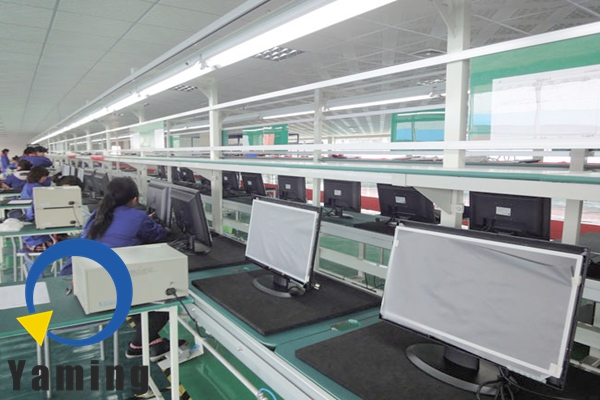
 Highly automated TV production lines: Process and equipment overview Our factory’s TV production line is a sophisticated, complex, and highly integrated manufacturing system. It is specially designed for efficient and high – precision electronic product assembly. The production line covers four core process stages. It integrates advanced automation technology, intelligent monitoring systems, and standardized operating processes. This ensures stable and unified output quality. Meanwhile, it focuses on efficiency optimization throughout the production cycle.
1. Precision Panel Processing Line: High – Cleanliness & Micro – Precision Assembly
The precision panel processing line’s first stage has a dedicated panel processing system. First, an anti – static conveyor belt transports original panels to the ultrasonic cleaning station. The cleaning equipment uses high – frequency sound waves to remove fine dust and oil from the panel surface. A built – in particle sensor monitors the cleaning effect in real time. It ensures a 99.9% cleaning rate – a key step to avoid display flaws. After cleaning, an automated die bonder uses vision – guided positioning technology (±0.02 mm accuracy). It attaches driving components to the panel precisely. It also has a real – time torque monitoring system. This prevents panel damage from excessive pressure. This section uses continuous operation. It can process up to 300 panels per hour.
2. Component Assembly & Material Handling Line: CNC Precision + AGV – Enabled Traceability
The component assembly and material transportation line integrates CNC machining and robot assembly for cabinet components. CNC punches cut and shape aluminum/ABS sheets. Machining tolerance is within ±0.1 mm. Then, automated deburring equipment removes corners and burrs for product safety. Meanwhile, an AGV fleet, dispatched by the Central MES, distributes motherboards, speakers, and power supplies to 12 assembly stations accurately. Each workstation has a smart torque wrench and barcode scanner. All part installation info uploads to the cloud in real time for full traceability. The production line is highly flexible. By changing fixtures quickly, it adjusts production for different – sized products in just 15 minutes.
3. Integrated Testing & Quality Control Line: 5 – Stage Automated Inspection with 99.5% Pass Rate
After assembly, products enter a continuous inspection line. They go through five dedicated inspection stations:
(1) Appearance inspection: A camera – based vision system checks for defects.
(2) Electrical performance testing: Measures voltage, current, and signal stability.
(3) Functional testing: Verifies button response, display output, and connections via automated scripts.
(4) Environmental adaptability testing: Simulates temperature/humidity changes to test stability.
(5) Mechanical durability testing: Simulates drops/impacts to check structural strength. Each station is automated. Testing data analyzes in real time. Failed products get marked and sent to maintenance. Qualified ones get exclusive QR codes for lifecycle traceability. The line processes 200 products per hour, with a 99.5% pass rate.
4. Intelligent Production Management System: 24/7 IoT – Connected Operations with 1200 Units/Day Capacity
The entire production line connects fully via IoT sensors. They collect equipment status, production speed, and material inventory data in real time. The MES dashboard shows key indicators (OEE, downtime rate, output) visually. When equipment needs maintenance or materials run low, the system sends early warnings. This cuts unplanned downtime by 20%. The line runs 24/7 with minimal manual intervention. It has a 1200 – unit daily capacity. Also, mass customization (e.g., brand logo printing, interface adjustments) is possible via software – no physical equipment changes needed.