1. Production Line Overview

The air purifier production line is an automated system for manufacturing air purification equipment. It follows five core steps: core component processing, filter module integration, complete machine assembly, performance testing, and finished product packaging. Leveraging precision tools and modular processes, it transforms raw materials into purifiers compatible with home, commercial, and vehicle-mounted scenarios. It supports flexible production for diverse specifications, including HEPA H13/H14 filtration and 100–800m³/h air volumes.

2. Core Component Processing Line

As the foundation of purification, this line ensures component adaptability and durability through “high precision + stability”. CNC punches cut cold-rolled steel plates (error ≤0.1mm), reserving slots for fans and filters. These plates are bent into frames via CNC, with corners polished and coated in rust-proof material. Plastic parts (panels, air ducts) undergo automated injection molding using flame-retardant ABS, with post-forming checks for bubbles and cracks. Functional components are pre-treated: fans undergo dynamic balance tests (operating noise ≤35dB), HEPA filters are integrity-tested (no leakage), and activated carbon filters are calibrated (formaldehyde adsorption rate ≥90%). All parts are scanned and marked for traceability.

3. Filter Module Integrated Assembly Line

Adopting a “layered assembly + sealing control” model, this line ensures purification efficiency and airtightness. Conveyors transfer fuselage frames to stations: the first installs primary filters (to intercept large dust particles), followed by superimposing HEPA filters (H13/H14 level, PM2.5 filtration efficiency ≥99.97%) and activated carbon filters. Sealing rubber rings are added to filter edges to prevent air leakage. AGVs distribute electronic control panels and sensors (PM2.5, formaldehyde), which workers fix using positioning tooling. High and low-voltage lines are physically isolated, and fan/sensor wiring is reinforced. A final air pressure test (0.2MPa, 20-second hold) ensures seamless bonding between the filter and body. During assembly, filter specifications are recorded via code scanning to avoid mismatches.

4. Complete Machine Assembly Line

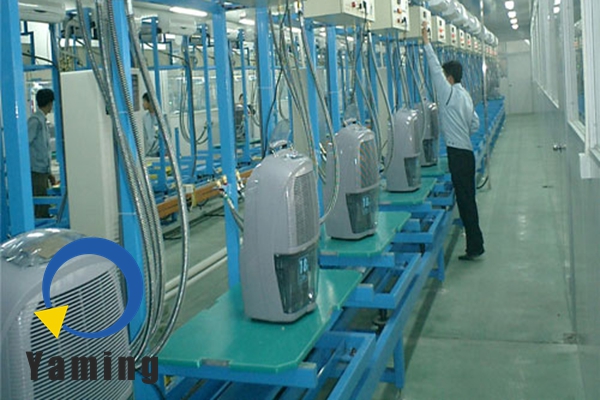
Using a “flow station + man-machine collaboration” design, this line integrates the purifier and refines functions. Conveyors transport frames (with integrated filter modules) to workstations, where fans and air ducts are installed. Fan speeds are debugged to adapt to different air volume gears. Control panels (touch/button type) and display screens (real-time air quality monitoring) are added, followed by power cord connections (with overload protection). Body panels are secured with buckles and screws to ensure a tight seal. Product labels (model number, purification level, air volume, safety certifications) are applied, and the entire system is checked for assembly integrity.

5. Full-Performance Testing Line

Equipped with multi-station tests, this line ensures purifier performance, safety, and durability meet standards. First, appearance and seal inspections check for panel scratches, component flatness, and body airtightness (no leakage). Electrical safety tests verify insulation resistance (≥200MΩ) and leakage protection (power cutoff within 0.1 seconds). Core performance testing measures purification efficiency in enclosed cabins (PM2.5 concentration reduced from 500μg/m³ to ≤10μg/m³ in 30 minutes). Air volume accuracy (simulated leakage ≤±5%), noise levels (high gear ≤60dB), and 100-hour continuous operation stability are also verified. Test data is uploaded in real time; unqualified products are diverted for repair, while qualified ones proceed to packaging.

6. Finished product packaging and storage line

The conveyor line focuses on protecting precision filters and electrical components during transportation and warehousing. The qualified purifier is placed in a tampon bag and then packed into a custom-sized carton. The body and accessories (remote control, manual) are fixed with pearl cotton to avoid damage. The label on the box marks the model number, purification level, production batch and handling warnings (prevent moisture, be careful during transportation). The automatically guided vehicle transports the boxes to the smart storage area, sorting them by “scene type + air volume”. The system updates inventory in real time and monitors temperature/humidity to prevent filter damage due to moisture, ensuring a seamless process from production to warehouse.

7. Core advantages of the production line

Efficiency and safety: The automation rate of core processes (component processing and assembly) exceeds 75%, and the accuracy of key size is improved. Purification performance and electrical safety testing are 100% covered to ensure effective and safe operation. Flexible production: Supports mixed-line production of household, commercial and vehicle-mounted purifiers. Product changes (through mold changes and filter specification adjustments) are completed within 1 hour to meet diverse market needs. Intelligent management: The MES system collects real-time production data (e.g., filter pass rate, defect detection rate), and improves equipment failure early warning response by 25%. Each purifier has a unique traceability code, which can track the entire production process to achieve quality control and after-sales service.

  • If you have any questions or needs about the automated assembly line, please contact us via email: [email protected]
Yaming