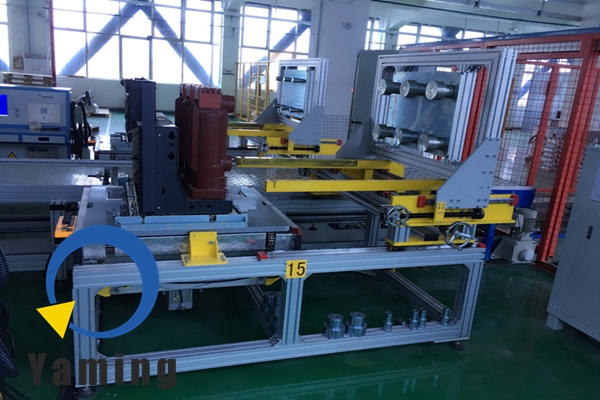
由 Yaming
 A complete circuit breaker assembly line consists of multiple systems operating in conjunction, each system performing its own duties to ensure a smooth production process:
1. Overall Introduction
A complete circuit breaker assembly line has multiple systems working together. Each system does its job to ensure smooth production.
2. Parts Conveying System: “Transportation Center” for Precision Transfer
The parts conveying system is the production line’s “transportation center”. It uses precision belt lines and index disc mechanisms. These convey circuit breaker casings, trippers, contacts, etc., to stations based on production rhythm. For small circuit breakers: The system transfers 15–20 parts per minute. Positioning error stays within ±0.5mm. This ensures assembly accuracy.
3. Automated Assembly System: Robot – Driven “Core Execution Unit”
The automated assembly system is the line’s “core execution unit”. It relies on multi – axis robots and servo modules. They handle grabbing, aligning, pressing circuit breaker parts automatically. Example (trip assembly): Robots embed coils, iron cores into housings precisely. Pressing force error is ≤5N. Efficiency is 4–6x higher than manual. It avoids component damage from human operation.
4. Performance Testing System: “Quality Gatekeeper” with ≥99.8% Pass Rate
The performance testing system acts as the line’s “quality gatekeeper”. It integrates conduction, overload trip, and insulation resistance tests. Each assembled breaker enters the test station automatically. Requirements: Insulation resistance ≥100MΩ; overload trip time in range. Unqualified products get sorted out. Test pass rate exceeds 99.8%.
5. Data Traceability & Management System: “Smart Brain” for Lifecycle Tracking
The data traceability system is the line’s “smart brain”. Based on industrial Internet tech, it collects real – time production data (time, operators, test params) for each breaker. It generates a unique traceability code. Enterprises use codes to check a product’s full lifecycle info. This helps trace quality issues and optimize production (e.g., adjust workstation assembly speed via data analysis).